Share on social
Highlights
Every pricing strategy starts with Regular Price.
Regular Price is the standard, non-promotional price of a product throughout its lifecycle. It is the driver of how a product enters the market, how customers respond to it, how quickly inventory moves, and how much flexibility retailers have later in the season.
When the Regular Price is aligned with customer demand, retailers are better positioned to generate more full-price sales, protect margins, and maintain healthy inventory levels.
The most successful retailers build their pricing strategy relying on accurate demand forecasting to understand how customers are likely to respond at different price points and continuously adjusting pricing decisions as the product moves through its lifecycle.
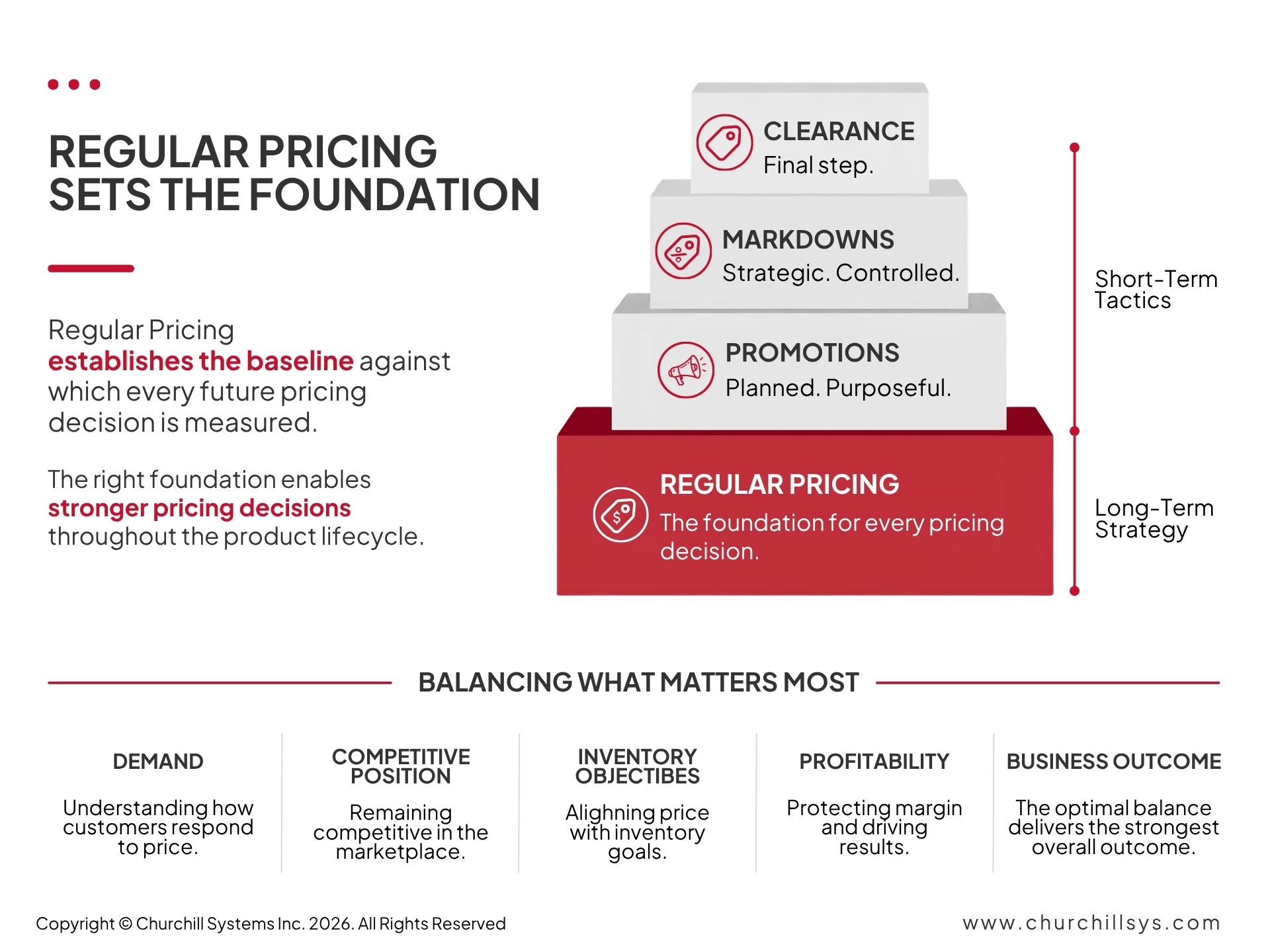
Regular Pricing Sets the Foundation
Regular Price is not simply the price assigned when a product enters the market. It is the product’s standard, non-promotional price throughout its lifecycle — and the baseline against which promotions, markdowns, and other pricing actions are measured. As market conditions and customer demand change, Regular Price itself may also need to be adjusted.
The ultimate pricing challenge is finding the balance between remaining competitive and protecting profitability.
When Regular Price is misaligned with demand, promotions and markdowns shift from strategic, planned pricing actions to reactive measures used to compensate for underperformance.
These interconnected pricing decisions are often managed separately. Regular Pricing may be owned by one team, promotions by another, and markdowns by another — each working toward different objectives and often with limited visibility into how one pricing decision impacts the overall business goals.
This fragmented approach can make it difficult to distinguish the source of underperformance. A promotional issue may actually originate with the Regular Price. Increased markdown exposure may be the downstream result of demand that never materialized at the baseline price. Without a common view of expected demand, teams can end up responding to the symptoms rather than addressing the underlying pricing issue.
The objective isn’t simply to maximize sales volume or gross margin independently. It’s to establish the baseline price that delivers the strongest overall business outcome by balancing demand, profitability, inventory objectives, and competitive positioning.
When Regular Pricing Misses the Mark
When products are priced above what customers are willing to pay, the first indication may simply be slower-than-expected demand. But as the gap between expected and actual demand persists, the consequences begin to compound.
Inventory remains on hand longer than planned, tying up working capital and occupying space that could otherwise support better-performing products. Sell-through falls behind plan, increasing pressure to intervene before inventory becomes aged or seasonal relevance begins to decline.
Promotions are often the first corrective action. But if the underlying Regular Price was significantly misaligned with demand, temporary discounts may not be enough to restore the expected sales trajectory. Retailers may respond with more frequent promotions or greater discount depth, gradually eroding the margin assumptions established at the beginning of the lifecycle.
The problem becomes even more difficult when these decisions are evaluated independently. A promotion may appear to underperform. A markdown may seem too deep. Clearance inventory may look like the result of poor end-of-life execution. Yet each of these outcomes may trace back to the same upstream issue: the product entered the market at a Regular Price that did not accurately reflect customer demand.
The opposite scenario carries its own risks. When Regular Price is set below what customers are willing to pay, strong initial sell-through can appear successful while masking lost margin opportunity. Inventory may move faster than planned, potentially creating stockouts or leaving insufficient inventory to capture demand later in the selling period.
Effective Regular Pricing therefore requires more than selecting a price that generates sales. It requires understanding how demand is likely to respond at different price points and identifying a baseline that supports the broader financial and inventory objectives for the product.
When that foundation is established correctly, products have a greater opportunity to sell consistently at full price. Promotions can be used strategically rather than correctively. Markdown exposure can be reduced, and clearance becomes the exception rather than the expected conclusion of the product lifecycle.
Using AI-based Demand Forecasting to Optimize Regular Pricing
The challenge for retailers is that there is rarely a single “correct” price.
Customer demand varies by location, store format, demographics, seasonality, competitive activity, and countless other factors. The price that maximizes profitability in one market may not produce the same outcome in another.
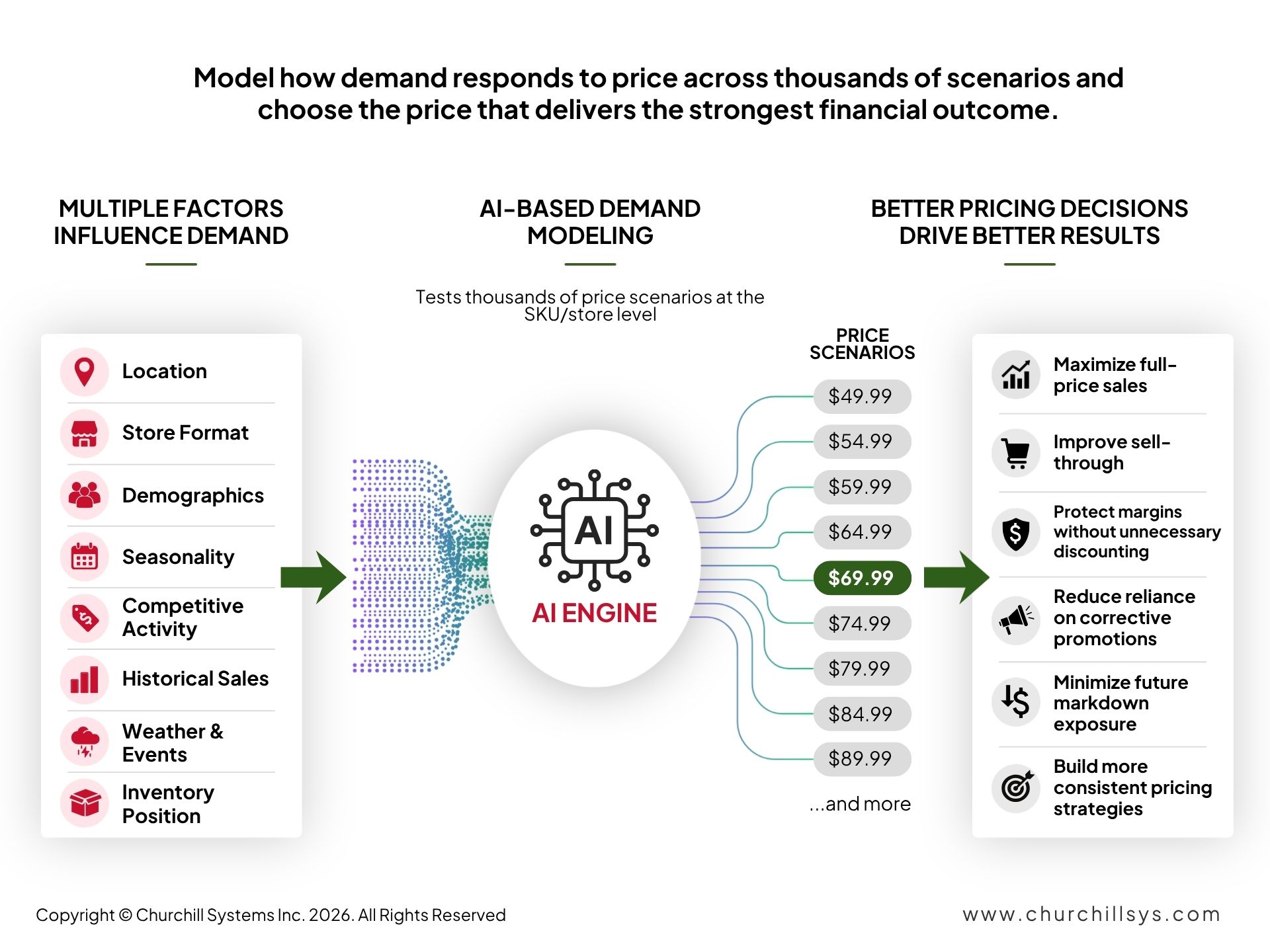
Churchill’s Regular Price Elasticity Module™ (RPE) helps retailers model how demand responds to different price points at the SKU/store level, providing predictive visibility before pricing decisions are implemented.
By understanding customer price sensitivity and the expected demand impact of potential price changes, retailers can establish competitive baseline prices while identifying opportunities to maximize profitability.
Rather than relying on historical averages, manual estimates, or rigid pricing rules, retailers can make more informed pricing adjustments based on expected customer response.
This enables retailers to:
- Establish initial Regular Prices based on expected customer demand
- Balance competitive positioning with profit objectives
- Understand customer sensitivity to price changes
- Evaluate potential pricing adjustments before implementation
- Protect margins without unnecessary discounting
- Reduce reliance on promotions and markdowns as corrective measures
- Build more consistent, demand-driven pricing strategies
The Financial Impact Starts with Regular Price
Regular Pricing decisions compound across every unit, SKU, store, and market in which they are implemented. Even relatively small misalignments between price and demand can translate into significant financial exposure at scale — through margin erosion, inefficient use of working capital, lost revenue, and reduced profitability.
This is why Regular Price should not be viewed as an isolated pricing decision. It establishes the financial foundation upon which promotions, markdowns, inventory performance, and ultimately the profitability of the product lifecycle are built.
For seasonal products, where the window to capture demand is finite, that visibility becomes even more critical. The earlier pricing decisions are aligned with demand, the greater the opportunity to protect profitability throughout the season.
Learn how Churchill’s Regular Price Elasticity Module™ can help your organization use demand intelligence to strengthen Regular Pricing decisions and improve financial performance.
Contact Churchill to discuss your Regular Pricing strategy.