Why Allocation Accuracy Depends on Demand Visibility

Share on social

Highlights

Allocation remains one of the largest sources of hidden financial leakage in retail. 

The challenge is that many of its costs never appear as obvious failures. 

Products sell. Inventory moves. Reports show healthy execution. 

Yet beneath those metrics, retailers may be losing millions in revenue, carrying excess inventory, and increasing operational costs without realizing the common thread connecting them. 

Demand forecasting is that common thread. 

Allocation decisions are only as accurate as the demand signals behind them. When demand is forecasted incorrectly, inventory is positioned in the wrong locations, creating a chain reaction of operational inefficiencies and financial losses throughout the retail network.

Let’s examine the most common areas where financial leakage occurs — and why so many of them can be traced back to a single root cause: poor demand forecasting.

Hidden Cost #1: The Revenue You Never Captured 

The most obvious consequence of poor Allocation is also the most difficult to measure. 

Lost sales. 
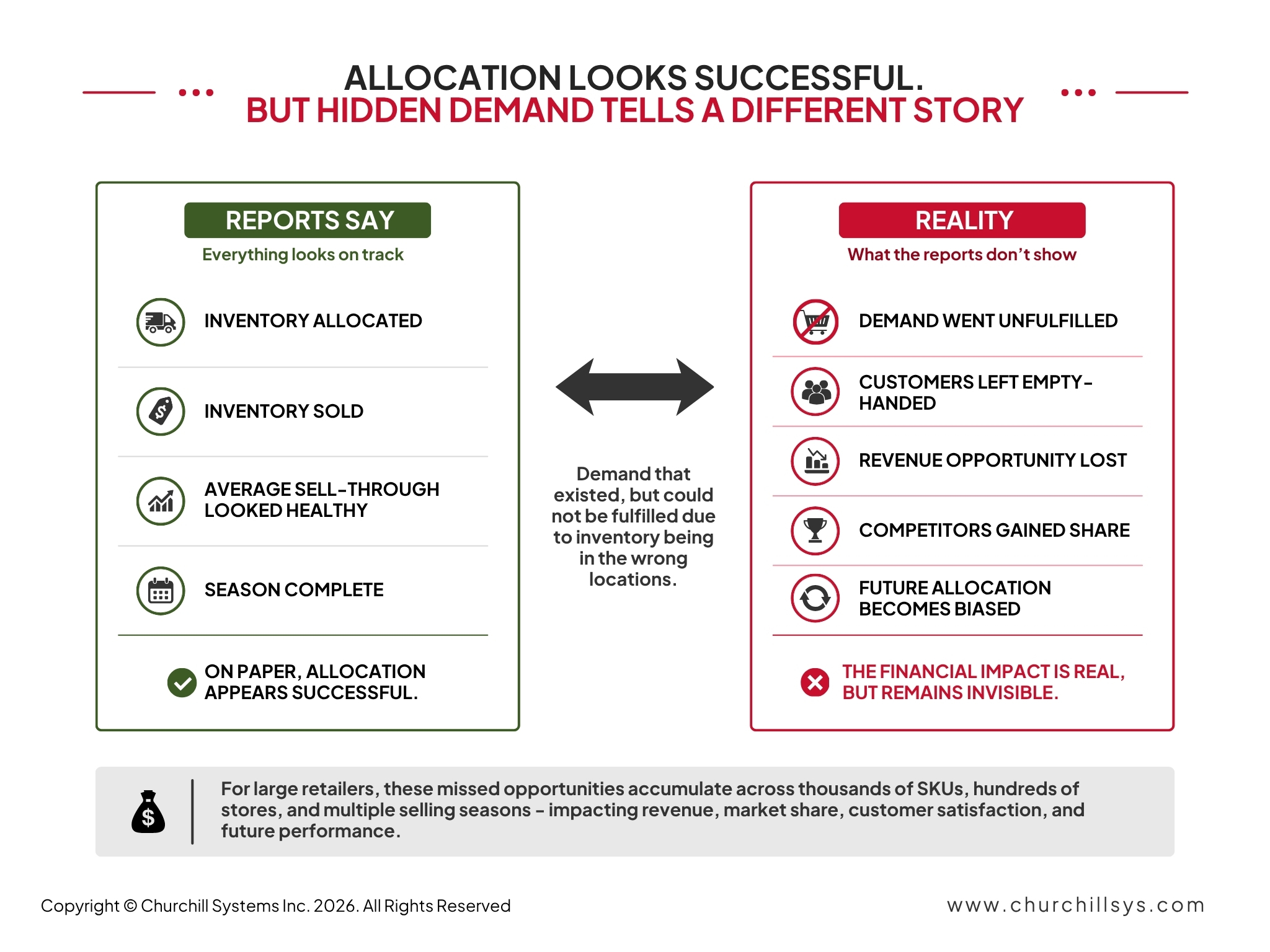
When inventory is allocated to the wrong locations, some stores receive too little inventory to meet demand. The result is that high-performing stores stock out weeks before demand subsides.

From a reporting perspective, a product may appear successful.

Inventory sold.

Sales occurred.

The season moved forward.

What often remains invisible is the revenue opportunity that never materialized.

For large retailers, these missed opportunities can accumulate across thousands of SKUs, hundreds of stores, and multiple selling seasons. The result is not simply lower sales. 

It is lower market share, reduced customer satisfaction, and revenue that competitors are happy to capture instead. 

Constrained sales frequently become the signal used to determine future Allocation quantities, reinforcing the same inventory imbalances season after season.

Hidden Cost #2: Excess Inventory Quietly Erodes Profitability
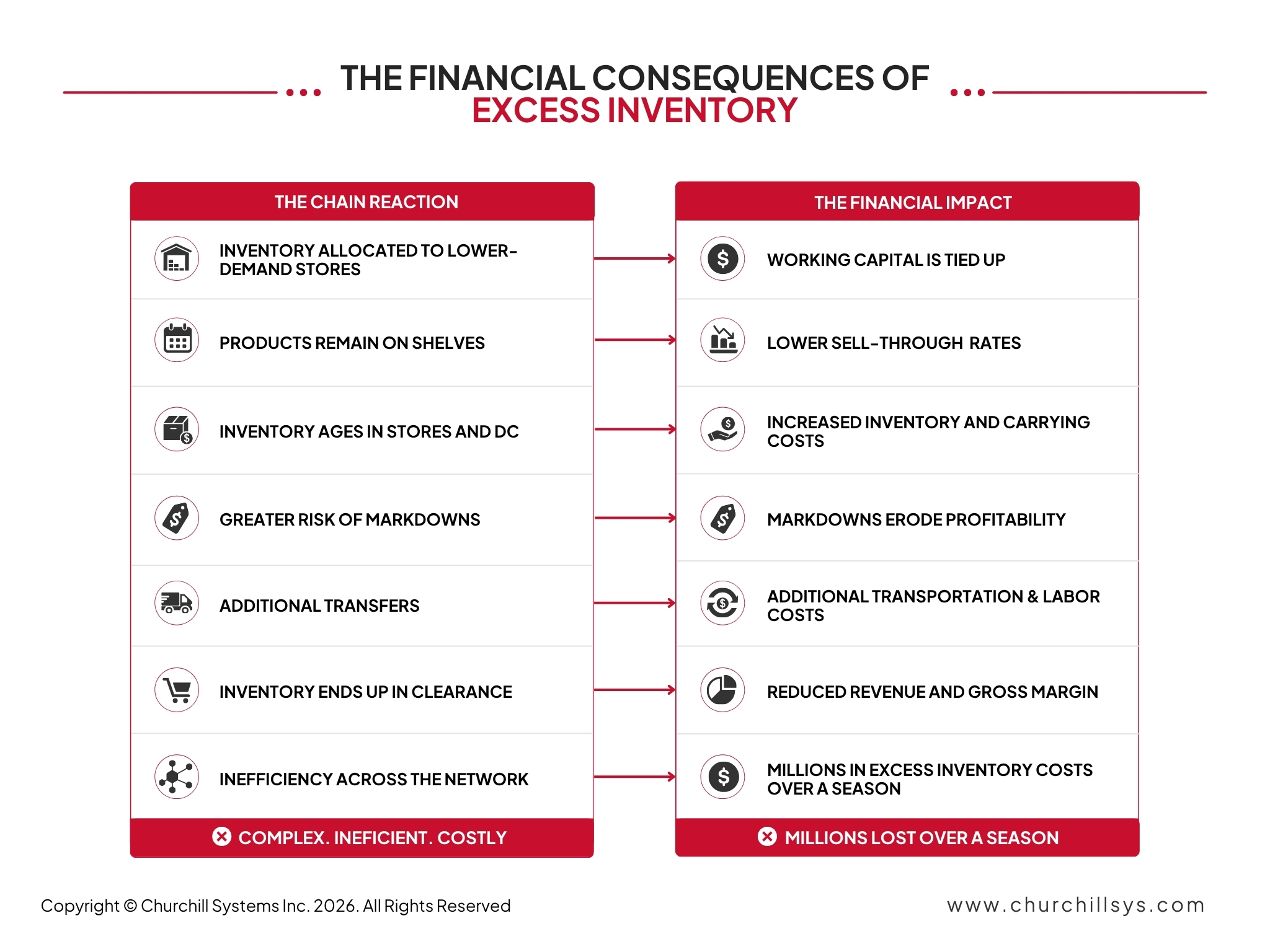
When inventory is allocated to stores where demand is weaker than expected, products remain on shelves longer than planned.

What initially appears to be “available inventory” gradually becomes a chain reaction of financial consequences.

  • Working capital remains tied up in slow-moving inventory
  • Sell-through rates decline
  • Inventory carrying costs increase
  • Markdown risk grows as seasons progress
  • Distribution centers may process additional transfers to rebalance inventory at additional cost
  • Some inventory ultimately reaches clearance, reducing gross margin

For retailers operating across hundreds or thousands of stores, even small Allocation errors can compound into millions of dollars in excess inventory costs over the course of a season.

Better Demand Visibility Creates Better Allocation Outcomes

At Churchill, we believe Allocation is only as effective as the demand forecast behind it. When retailers understand where demand is expected to occur, inventory can be distributed accordingly, improving product availability in high-demand locations while reducing excess inventory elsewhere in the network.

Retailers cannot consistently place inventory in the right locations if they do not have a clear understanding of underlying demand.

For more than 35 years, Churchill has helped enterprise retailers uncover the demand signals hidden beneath stockouts, inventory constraints, seasonal volatility, and other sources of distortion.

This enables more informed decisions across Allocation, Replenishment, Purchasing, Pricing & Promotions.

Allocation is rarely where the problem begins. It is simply where the financial consequences become visible.

And the retailers that improve demand forecasting upstream gain a measurable advantage in revenue, inventory productivity, and Supply Chain efficiency.

Hidden Cost #3: Supply Chain Efficiency Begins to Break Down

The operational consequences of ineffective Allocation often spread far beyond stores.

As inventory imbalances grow, Supply Chains become increasingly reactive:

  • Transfer activity rises
  • Emergency Replenishment requests increase
  • Distribution centers process additional inventory movements
  • Planning teams spend more time managing exceptions
  • Merchants and planners override recommendations more frequently

Over time, these activities create friction throughout the organization:

  • Transportation costs increase
  • Labor requirements grow
  • Inventory visibility becomes more complex
  • Decision cycles become slower

What begins as an Allocation issue gradually becomes a Supply Chain efficiency issue.

Many retailers attempt to address these symptoms through additional processes, new allocation rules, or manual intervention.

But these efforts often address the consequences rather than the source of the problem.

Because the Allocation engine itself is typically executing exactly what it was designed to do.

Improving demand forecast accuracy at the level where Allocation decisions are made enables retailers to address these challenges at their source, reducing the need for downstream correction while improving inventory productivity across the network.

Download the Churchill brochure below to learn more about our proprietary software solutions.

This field is for validation purposes and should be left unchanged.