What Your Purchasing Decisions Are Really Costing You

Share on social

Highlights

How to Optimize Total Buy Quantity with AI Demand Forecasting

There is a critical moment in every Merchandise Planning cycle that determines whether a season will be profitable or painful. It happens before a single unit ships, before a product appears on a shelf, before any customer sees a price tag. It happens when a Buyer commits a number.

That number — the Total Buy Quantity — is one of the single most consequential decisions in retail planning. 

Get it right and you maximize sell-through, protect margin, and satisfy customers.

Get it wrong in either direction and the consequences ripple through your entire organization: upstream into vendor relationships and assortment strategy, and downstream into allocation, replenishment, pricing, and ultimately, profitability.

The True Cost of Getting Your Buy Quantity Wrong

Before exploring the solution, it is worth understanding just how costly imprecise purchasing decisions can become.

According to IHL Group’s Fixing Inventory Distortion study, the total cost of inventory distortion — the combined effect of overstocks and stockouts — reached $1.7 trillion globally in 2024Out-of-stocks alone accounted for $1.2 trillion of that total, while overstocks contributed another $554 billion in markdowns, disposal costs, and tied-up capital.

In an environment where operating margins can be razor-thin, a single bad season can take years to recover from.

Behind most of that $1.7 trillion is the same failure: purchasing commitment made without a reliable demand forecast to back it up.

Purchasing Decisions Are Not Isolated — They Cascade

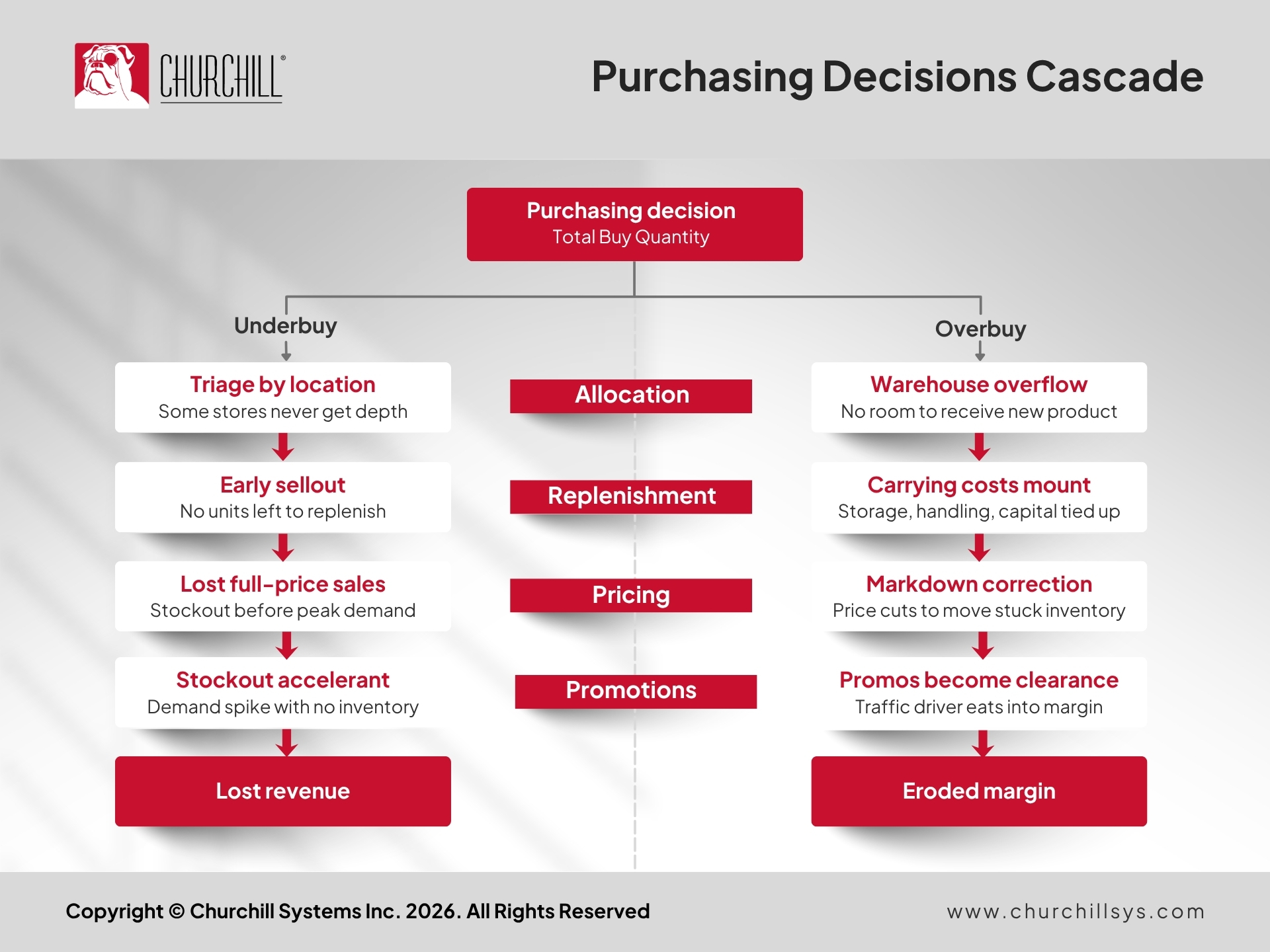
One of the most important and least-discussed aspects of Purchasing is how far its effects travel through the organization. A wrong buy quantity does not just affect inventory levels. It reshapes almost every downstream planning process.

Allocation and replenishment depend entirely on the total buy being sufficient. Underbuy — and allocation teams are forced to triage: some stores win, others don’t. Overbuy and you are left with a warehouse full of inventory (and its carrying costs).

Pricing strategy is forced to respond to purchasing errors. Markdowns are not a pricing strategy — they are a purchasing correction.

Promotional planning is distorted when inventory levels are misaligned with demand. Too much inventory turns a promotion into a clearance event. Too little turns it into a stockout.

Merchandise management is affected upstream as well. If purchasing decisions consistently over- or under-represent certain categories, category health metrics — sell-through rates, inventory turns, gross margin return on investment — will tell a misleading story. Planning for the next season’s assortment will be built on corrupted data.
How AI-based Demand Forecasting Changes Purchasing

The purchasing decisions are only as good as the demand intelligence behind them.

Modern AI-based demand forecasting platforms ingest and evaluate multiple demand signals simultaneously: historical sales patterns, promotional lift data, seasonal patterns, regional demographic information, competitive dynamics, and in some cases, external signals like weather and macroeconomic indicators. The result is a forecast built on a complete picture of true demand — not just the portion that happened to transact.

AI-powered demand forecasting sees everything that drove — or failed to drive — a sale.

Gartner’s analysis of AI deployments in supply chain planning found demand forecasting accuracy improvements of 20–40% — a range that translates directly into fewer stockouts, leaner inventory positions, and reduced markdown exposure. Gartner also projects that 70% of large organizations will have adopted AI-based forecasting by 2030 — a signal of where the industry is heading, and how quickly the window for competitive advantage is closing.

Which Retail Roles Are Most Impacted by Demand Forecasting Errors

Who Needs to Care — and Why

erchandise Managers and Their Buyers are the most directly exposed to forecasting error. Their professional reputation, and their performance metrics, are tied directly to sell-through rates and markdown rates. A buyer working with imprecise demand data is asked to make high-stakes financial commitments in a state of uncertainty. AI-powered forecasting doesn’t remove a buyer’s judgment from the process — it gives that judgment a reliable foundation. Buyers who have access to granular, SKU-level demand forecasts that incorporate lost sales and localized demand profiles make fundamentally better decisions. They can also negotiate with suppliers from a position of data-backed conviction rather than estimate-based guesswork.

Chief Merchandising Officers/VPs Merchandise Planning carry responsibility for the intersection of demand, inventory, and financial goals across the entire business. The cost of getting this wrong is not just operational — it shows up directly in working capital, GMROI, and gross margin percentages reported to leadership. Retail decisionmakers who have invested in AI-powered demand forecasting report meaningful improvements in inventory turn, reductions in markdown rates, and improved alignment between merchandising strategy and financial outcomes. Perhaps most importantly, they gain the cross-functional coordination tool that merchandise planning requires: a shared data source that aligns merchandising, supply chain, and pricing teams around a single picture of demand.

Download the Churchill brochure below to learn more about our proprietary software solutions.

This field is for validation purposes and should be left unchanged.