Share on social
Highlights
Markdowns Are a Reality of Retail.
As seasonal merchandise reaches the end of its lifecycle, new assortments need floor space, and old inventory needs to move. Regardless of why sell-through goals were not achieved, the business still needs to clear the remaining merchandise.
While markdowns may be unavoidable, the financial impact of those decisions is not predetermined.
Every price reduction represents a trade-off between protecting margin and generating enough demand to move inventory within the remaining selling window.
The challenge is determining how much margin a retailer needs to give away, when, and where, to achieve its sell-through objectives.
The Markdown Isn’t the Strategy. Demand Is.
Traditional markdown decisions can rely heavily on rules, schedules, historical averages, or predetermined discount ladders.
These approaches provide structure and consistency, but they don’t necessarily account for how customers will respond to a particular price at a particular point in the merchandise lifecycle.
And that’s the critical distinction.
A markdown is a pricing action. Its effectiveness depends on the demand it generates.
AI-based demand forecasting allows retailers to evaluate potential price reductions against expected consumer demand, available inventory, remaining selling time, and business objectives. It allows retailers to make pricing decisions based on what each item needs to achieve its sell-through target.
Without that visibility, even a well-established markdown process can leave a significant margin on the table.
Where Markdown Strategies Leave Margin on the Table
There isn’t one markdown problem. There are many ways a markdown strategy can underperform.
Markdowns That Are Too Deep.
Deeper discounts may accelerate sell-through, but they can also unnecessarily erode margin. An item marked down to $40 may sell quickly, but if customers would have readily purchased it at $50, the retailer has given away $10 on every unit sold.
Markdowns That Aren’t Deep Enough.
Being too conservative can be costly, too. If a markdown doesn’t generate enough demand, valuable selling time is lost, and a much deeper discount may be required later.
Markdowns Taken Too Early.
Slow sales don’t always mean an immediate markdown is necessary. If an item is still on track to meet its sell-through target, reducing the price too soon can sacrifice margin on sales that could have occurred at a regular price.
Markdowns Taken Too Late.
The opposite creates another problem. Waiting too long can leave retailers with too much inventory and too little time to sell it. As the selling window closes, the options become more limited, and clearance event may be necessary.
The Same Markdown Everywhere.
Demand for the same SKU can vary significantly by store or location. A discount that is necessary in one location may be deeper than needed in another — or completely unnecessary somewhere else.
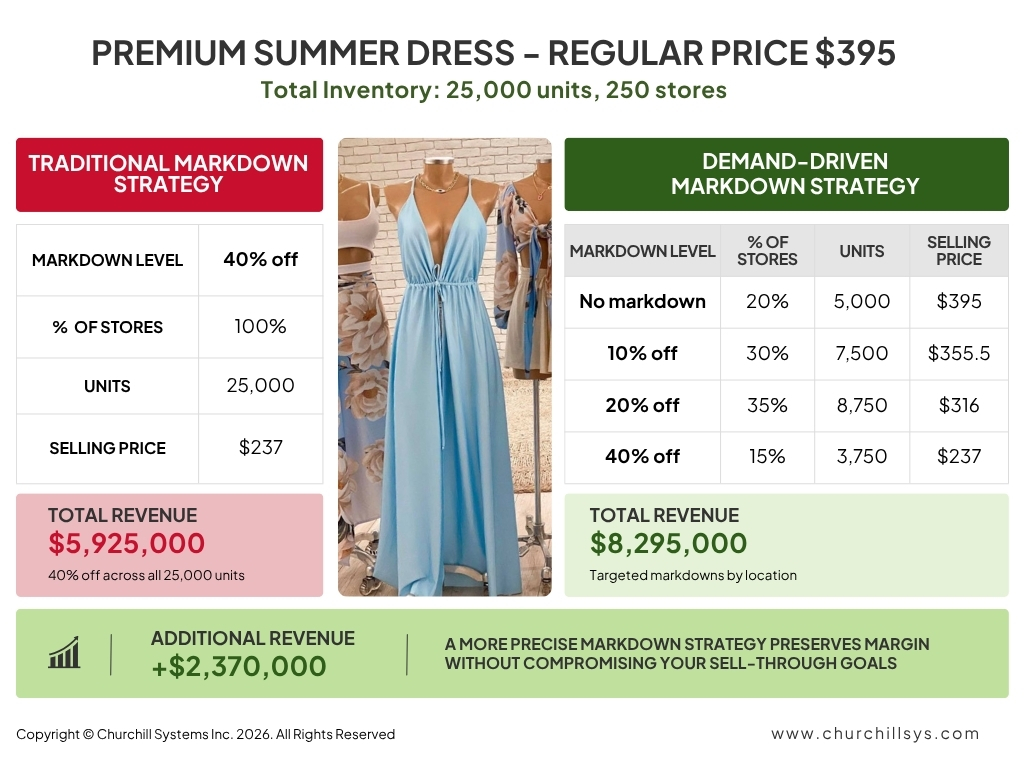
Markdown optimization requires understanding where action is necessary and how much action is required.
The Same Markdown Journey for Every Item.
Not every item needs to follow the same predetermined sequence of markdowns. Depending on demand, inventory, and remaining selling time, some items may require several markdown stages, while others may need fewer adjustments — or none at all.

An item might move from 20% → 30% → 50% based primarily on how long it has been on markdown.
But the passage of time alone doesn’t tell you what the next price should be.
A better question is:
At this price, given the inventory we have and the selling time remaining, are we generating enough demand to reach our objective?
If the answer is yes, another markdown may be unnecessary.
If the answer is no, maintaining the current price could simply delay an inevitable — and potentially much deeper — discount.
Each of these problems comes down to the same challenge: understanding how much demand exists, how it is likely to respond to a price change, and what action gives the retailer the best opportunity to reach its objective without giving away more margin than necessary.
Turning Demand Forecasting Into Markdown Price Optimization
At Churchill Systems, demand forecasting isn’t simply used to predict what will sell. It is used to help retailers understand the impact that pricing decisions will have on demand, at various times, by location.
Churchill’s Markdown Price Optimization (MPO) application tracks seasonal SKUs by location and generates the forecasts for their expected sell-through. It also identifies which SKU/locations are projected to miss, meet, or exceed their sell-through targets, recommending retailers what markdown decisions that will best meet their business objectives.
If an item is already on track to meet its target, an additional markdown could unnecessarily sacrifice margin. If it is projected to fall short, MPO evaluates alternative pricing options to determine whether a more profitable action is available.
When a better alternative is identified, MPO provides a recommended pricing action for approval — making markdown decisions more targeted, demand-driven, and focused on achieving sell-through objectives while protecting margin.
* * *
Ultimately, markdown optimization comes down to four fundamental decisions:
- When should we take the markdown?
- How many markdown stages should we take?
- What should the discount actually be?
- Which stores should receive the markdown?
Every Percentage Point Matters
Across thousands of SKUs and stores, even small markdown decisions can have a significant impact on profitability. The difference between a good markdown strategy and a great one isn’t necessarily how much inventory gets cleared, but how much margin the retailer retains in the process.
That’s where more accurate, AI-based demand forecasting makes the difference. By understanding how demand is likely to respond to different prices, retailers can make more informed decisions about when, where, and how deeply to discount at scale, across thousands of SKUs and stores – maximizing the value of their remaining inventory while achieving sell-through objectives.
Churchill’s Markdown Price Optimization (MPO) brings these capabilities together, helping retailers replace predetermined markdown schedules with targeted pricing recommendations based on forecasted demand.
Discover Churchill’s Markdown Price Optimization and request a demo.